Cassava Pressing Machine Working Principle and Capacity
FAQ/ Chat online/ Leave a message/ October 15, 2025
The cassava pressing machine is an essential piece of equipment in cassava processing, primarily used for dehydrating cassava, which directly impacts the efficiency of subsequent processing steps and the quality of the finished product. So, with so many models and manufacturers available, how can one scientifically select a high-performance cassava pressing machine? Understanding its basic working principle and production capacity characteristics is crucial for making an informed equipment selection.
This article, using Jinrui Foodtech's cassava pressing machine as an example, will detail its working principle and production capacity range, helping you select the most suitable model for your production needs.
Cassava Pressing Machine Working Principle Introduction
Jinrui Foodtech cassava pressing machine utilizes advanced hydraulic technology as its core working principle. Compared to traditional screw presses, this hydraulic system delivers high, yet controllable, pressure, achieving more efficient dehydration. The workflow of cassava pressing machine is divided into four main stages:
- Feeding Stage: The crushed and fermented cassava residue is evenly fed into the press chamber, preparing it for subsequent pressing.
- Pressing Stage: The motor drives the hydraulic system, applying uniform and powerful pressure to the pressing platens, gradually compressing the cassava residue and releasing its internal moisture.
- Dehydration Stage: Once the pressure reaches the set value, the cassava pressing machine maintains a stable high pressure for a specified period. During this process, free water and starch slurry are fully squeezed out, achieving efficient dehydration.
- Discharge Stage: After the pressing cycle, the hydraulic platens retract, and the resulting compacted cassava cakes are smoothly loaded from the machine, completing the dehydration process.
The entire hydraulic pressing process is powerful, stable in operation, and thorough in dehydration. Compared with traditional methods, the cassava pressing machine has significantly improved dehydration efficiency and effects.
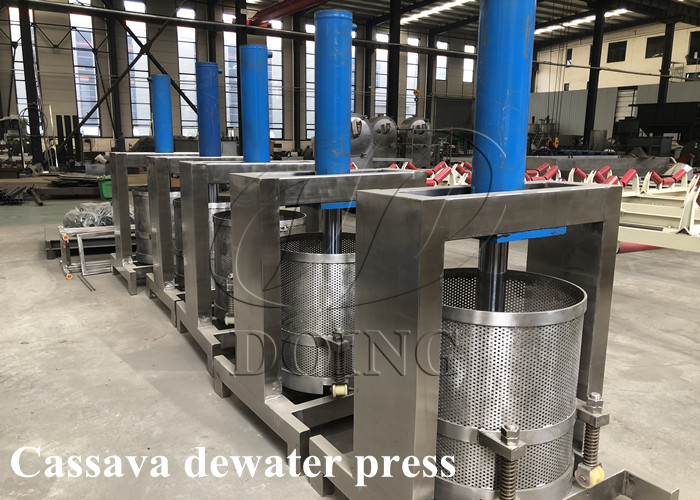 Cassava pressing equipment
The Production Capacity Range of Cassava Pressing Machine
The specific capacity of a cassava pressing machine depends primarily on the model selected and the material conditions. To meet the needs of customers of different scales, Jinrui Foodtech offers a variety of cassava pressing machine models. As shown in the table below, its mainstream models range from 450 to 850, with hourly processing capacities ranging from 200 kg to 1,400 kg, offering a broad production capacity range.
| Model | Capacity (KG/H) | Pressure (T) | Material |
| 450 | 250 - 300 | 5 -30 | SS304 |
| 550 | 450 - 600 | 5 -30 | SS304 |
| 650 | 700 - 900 | 5 -30 | SS304 |
| 750 | 950 - 1100 | 30 - 100 | SS304 |
| 850 | 1200 -1400 | 30 - 150 | SS304 |
Based on Jinrui Foodtech's previous customer purchase statistics, cassava pressing machine with a capacity range of 500 to 800 kg/hour are the most popular choice due to the excellent processing efficiency and practicality, best matching the production needs of most processors.
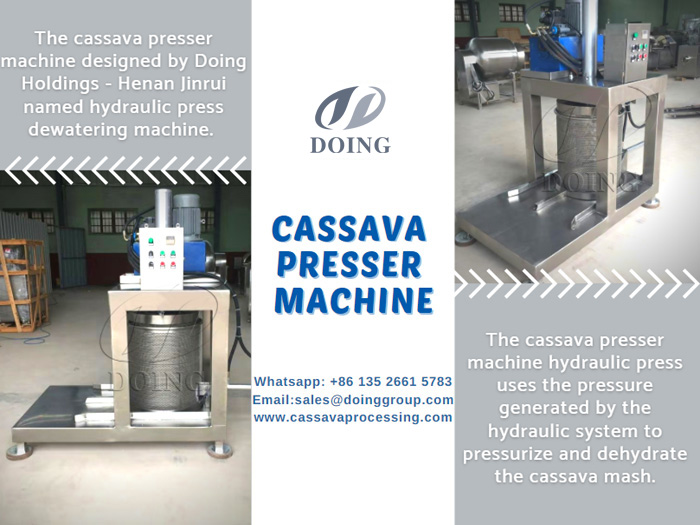 Jinrui Foodtech cassava pressing machine
The Advantages of Jinrui Foodtech Cassava Pressing Machine
1. High Processing Capacity: Jinrui Foodtech's cassava pressing machine combines a batch processing design with a powerful hydraulic system to ensure rapid dehydration of each batch of cassava, improving dehydration efficiency and thus processing capacity.
2. Excellent Dehydration: Jinrui Foodtech's cassava pressing machine applies constant pressure to the crushed cassava residue, reducing the moisture content to below 40%, achieving excellent dehydration effect.
3. High Automation Level: Jinrui Foodtech's cassava pressing machine is semi-automated, featuring one-touch start and stop functions, as well as automatic filtering, drainage, squeezing. This significantly improves processing efficiency.
In short, the working principle and production capacity of a cassava pressing machine are two core considerations when selecting equipment. Jinrui Foodtech's cassava pressing machine, with the powerful hydraulic pressing principle, ensures excellent dehydration results and stable processing capacity.
If you need a cassava pressing machine that can maximize capacity and efficiency, contact Jinrui Foodtech now to discuss your demands and find the perfect hydraulic press solution for your cassava plant!
Leave A Message
- Do you want to buy machine?
- Yes, I want to buy machine
- No, I want to learn more in advance
- What is your raw material?
- Cassava
- Potato
- Sweet potato
- Other:
- What type of equipment are you looking for?
- Single Machine
- Complete production line
- Which single machine do you want?
- Dry sieve
- Paddle washer
- Cassava peeler
- Cassava cutter
- Cassava grinder
- Cassava rasper
- Hydraulic press
- Garri fryer
- Cassava sieving machine
- Other:
- What type of equipment are you looking for?
- Complete production line
- Single Machine:
- What is the final product you want to produce?
- Chips
- Flour
- Starch
- What is the final product you want to produce?
- Garri
- Cassava flour
- Cassava starch
- Cassava chips
- Attiekie
- Bammy
- Other:
- How many tons of the final product do you want to process?
- <1 ton per day
- 1 ton per day
- 2 tons per day
- 3 tons per day
- 3-10 tons per day
- 10-20 tons per day
- >20 tons per day
- What is the usage of your cassava chips ?
- Food usage (like fried chips)
- Industrial usage (like animal feeds, ethanol, flour)
- How many tons of the final product do you want to process?
- <5 ton per hour
- 5-10 tons per hour
- >10 tons per hour
- How many tons of the final product do you want to process?
- <500 kg per hour
- 0.5-5 ton per hour
- 5-10 ton per hour
- >10 ton per hour
- What is your daily cassava input (tons)?
- Other: