Garri Equipment Upgrade: From Hand Processing to Higher Profits
FAQ/ Chat online/ Leave a message/ August 6, 2026
The garri processing industry faces two major challenges: rising labor costs and growing demand for consistent, high-quality garri. These two trends are squeezing profit margins for manual processing operations.
But a mechanized production line can change this. An entry-level line with a daily output of 1–3 tons requires only 3–5 workers, while the same output would need 15–25 workers manually – cutting labor costs by over 70%. At the same time, mechanization ensures consistent color, texture, and moisture across every batch – eliminating reliance on manual experience.
Lower cost, stable quality. That's the core logic of how mechanized upgrading breaks the profit squeeze.So, what exactly does it take to move from manual to mechanized production?
This article walks you through what to consider before upgrade, how to plan the upgrade, and what equipment a complete line includes.
Before you invest, answer three questions honestly. Getting clear on these now prevents costly mistakes later.
Question 1: What daily output do you actually need?
Start with your market, not with the biggest machine you can afford. Match your line capacity to real demand:
Local market only, 2–3 tons/day → Entry-level semi-mechanized line is sufficient
Regional distributors, 5–10 tons/day → Medium-scale fully mechanized line
Export buyers or industrial supply, 15+ tons/day → Large-scale line with automated feeding and packaging
Plan for where you want to be in 2–3 years, not just today. Adding capacity later costs more than designing it in from the start.
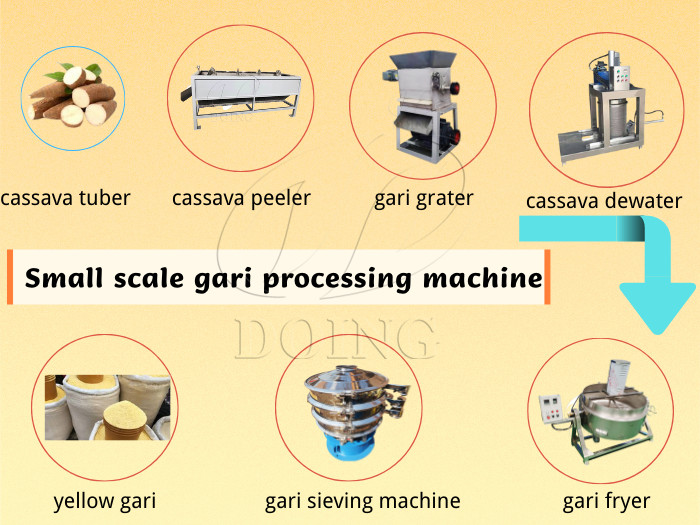 Small scale garri production line
Question 2: What fuel is reliable and cost-effective in your area?
The three options are gas, diesel, and electricity. The right choice depends on your location and local infrastructure:
Gas — Often the lowest operating cost where supply is stable
Diesel — More flexible in areas without gas pipelines
Electricity — Clean and easy to control but depends on stable power supply
Choose the fuel that gives you the lowest cost per batch in your specific location.
Question 3: Who will supply your equipment and support you after the sale?
The supplier relationship matters as much as the machine. Before you buy, verify:
Direct manufacturer or trading company? Direct manufacturers offer better pricing and deeper technical knowledge
Project experience in West Africa? Local conditions — humidity, power quality, cassava varieties — affect equipment configuration
Installation and training included? Equipment that arrives without proper commissioning produces below specification
Spare parts availability? Downtime costs more than the price difference between suppliers
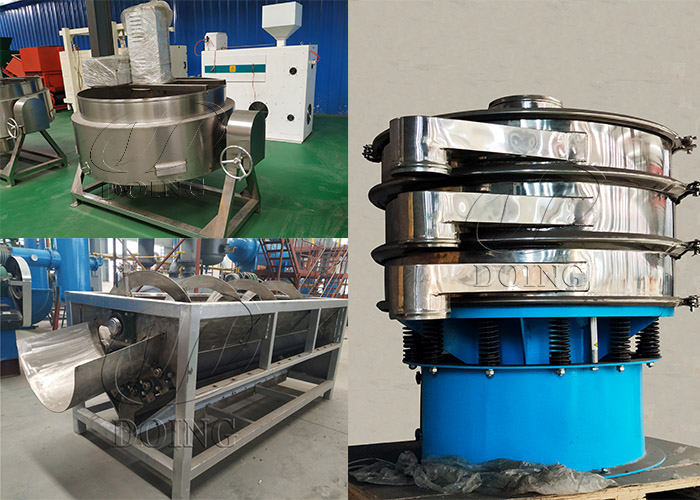 Garri processing equipment
Once you have the answers to the three questions above, planning the upgrade follows five steps.
Step 1: Assess your current situation
Know your actual daily output. Track it for a week — do not estimate. Identify your biggest bottleneck: is it the peeling stage? The frying stage? Knowing where you are now tells you what to fix first.
Step 2: Define your output goal
Decide how much garri you want to produce per day. Base this on your current demand plus a growth buffer of 20–30%. The line you choose should serve you for at least 3 years without needing a complete rebuild.
Step 3: Check your site conditions
Before selecting equipment, measure your floor space, confirm your power supply capacity, and verify your fuel availability. These hard constraints determine what equipment fits your plant — not the other way around.
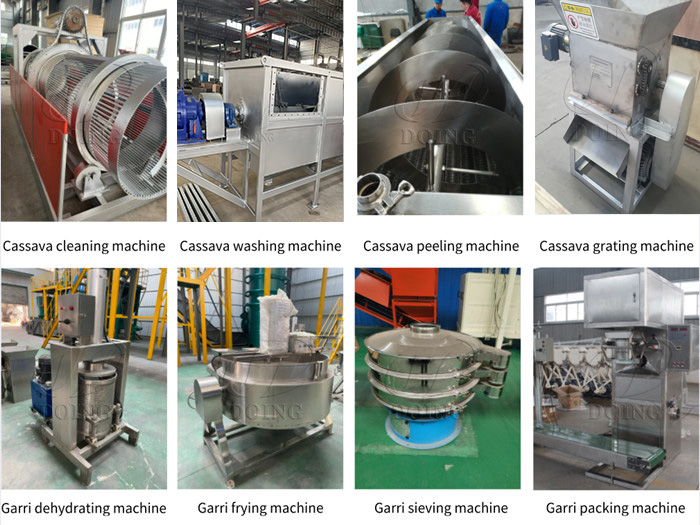 The right equipment for your garri processing
Step 4: Select your equipment configuration
Choose machines based on your output goal and site conditions. Decide how much automation you need:
Semi-automatic line — Lower upfront investment, requires more manual feeding and monitoring, suitable for 2–5 tons/day
Fully automatic line — Higher upfront investment, minimal labor requirement, suitable for 10+ tons/day
Step 5: Install, commission, and train your team
Equipment that is not properly commissioned underperforms. Choose a supplier who handles installation, calibrates the line to your cassava variety, and trains your operators to run it independently from day one.
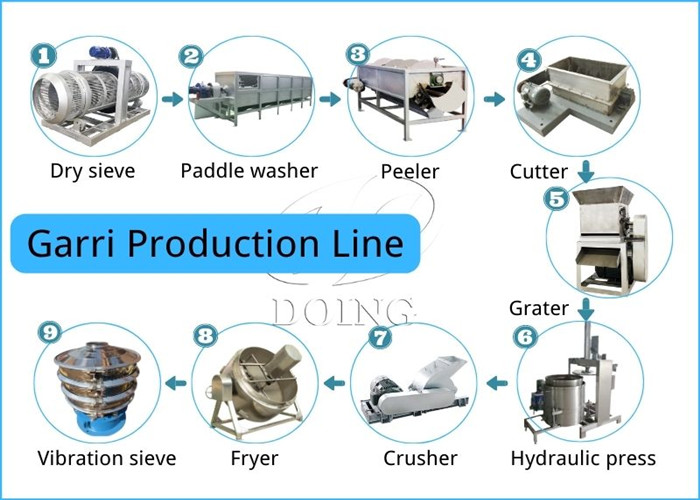 The complete garri production line
A standard mechanized garri production line runs through six processing stages. You do not need to buy every machine at once — many producers start with the core stages and add equipment as demand grows.
| Processing Stage | Equipment | Key Function | Typical Capacity |
| Cleaning | Cassava washing machine | Removes sand, stones, debris before peeling | 1–10 tons/hour |
| Peeling | Cassava peeling machine | Strips skin — replaces hours of hand peeling | 1–5 tons/hour |
| Grating | Cassava grating machine | Grates peeled roots into fine, uniform mash | 1–8 tons/hour |
| Pressing | Hydraulic or mechanical press | Removes excess water, controls fermentation | Matches line throughput |
| Frying | Garri fryer | Roasts pressed mash with controlled heat and stirring | 500 kg–2 tons/batch |
| Sieving & Packaging | Vibrating sifter + packaging machine | Sizes garri by texture, packages for market | Matches line throughput |
A complete garri production line is an investment that pays for itself through higher output, better quality, and lower labor costs. Henan Jinrui has years of experience designing and supplying garri processing equipment for producers worldwide. We provide solution design, installation, commissioning, and operator training — tailored to your target output and local conditions. Contact us to discuss your goals and get a customized upgrade plan.
Q1: Can I keep my existing machines and only add new ones?
A: Yes, if your existing machines are in good condition and match the capacity of new equipment. Henan Jinrui recommends a technical assessment first to avoid bottlenecks from mismatched capacities.
Q2: Do I need to stop production during the upgrade?
A: A phased installation usually allows partial production to continue. If replacing the entire line at once, expect 1–2 weeks of downtime. Plan your upgrade during a slower sales period when possible.
Q3: What is the warranty period for the equipment?
A: Henan Jinrui offers a 12-month warranty covering manufacturing defects and key components. After the warranty period, Henan Jinrui provides long-term technical support and spare parts supply, with faster delivery for customers in Nigeria and neighboring countries through our warehouse in Nigeria.
Q4: How long does it take to see a return on investment?
A: Small-scale lines (2–3 tons/day) typically reach payback within 12–18 months; medium-scale lines (5–10 tons/day) in 18–24 months. Actual ROI depends on your output increase and labor cost savings.
Q5: How long is the equipment lifespan, and what are the maintenance costs?
A: With proper maintenance, the equipment lasts 10–15 years. Daily maintenance involves basic cleaning and inspection; major servicing is needed once or twice a year. Maintenance costs are low compared to the value of continuous production.
Leave A Message
- Do you want to buy machine?
- Yes, I want to buy machine
- No, I want to learn more in advance.
- What is your raw material?
- Cassava
- Potato
- Sweet potato
- Other:
- What is the final product you want to produce?
- Chips
- Flour
- Starch
- What is the final product you want to produce?
- Garri
- Cassava flour
- Cassava starch
- Cassava chips
- Attiekie
- Bammy
- Other:
- What is your planned capacity for final product?
- <1 ton per day
- 1 ton per day
- 2 tons per day
- 3 tons per day
- 3-10 tons per da
- 10-20 tons per day
- >20 tons per day
- What is the usage of your cassava chips?
- Food usage (like fried chips, flour)
- Industrial usage (like animal feeds, ethanol)
- What is your planned capacity for final product?
- <5 ton per hour
- 5-10 tons per hour
- >10 tons per hour
- What is your planned capacity for final product?
- <500 kg per hour
- 0.5-5 ton per hour
- 5-10 ton per hour
- >10 ton per hour
- What is your planned capacity for final product?
- <300 kg per hour
- 300-1000 kg per hour
- 1-5 ton per hour
- 5-10 ton per hour
- >10 ton per hour