Why gluten-free cassava flour is so popular in Nigeria?
FAQ/ Chat online/ Leave a message/ March 11, 2026
Walk into any supermarket from Lagos to Kano, and you will find shelves stocked with gluten-free cassava flour, marketed not just to those with dietary restrictions but to health-conscious consumers everywhere. What is driving this popularity? How can entrepreneurs tap into this growing market by producing high-quality gluten-free cassava flour? Now let's break it down.
The Rising Popularity of Gluten-Free Cassava Flour in Nigeria
Public Health Consciousness
The health benefits of gluten-free cassava flour are the primary driver of its modern popularity. As awareness of celiac disease and gluten sensitivity grows globally, Nigerian consumers are recognizing that their traditional staple offers a natural solution. Cassava flour is inherently gluten-free, making it safe for those who cannot tolerate wheat, barley, or rye.
Beyond being gluten-free, cassava flour offers impressive nutritional credentials. It provides:
Dietary fiber for improved digestive health
Potassium for heart function and muscle health
Vitamin C for immune system support
Resistant starch that acts as a prebiotic, feeding beneficial gut bacteria
The mild, neutral taste and smooth texture of cassava flour make it an effortless substitute for wheat flour in countless applications. From bread and pastries to chin chin, puff puff, and the beloved traditional swallows like eba and fufu, cassava flour delivers authentic texture and flavor without compromise.
 gluten free cassava flour
Economic and Policy Drivers
Nigeria's position as the world's largest cassava producer creates a powerful economic foundation for cassava flour popularity. With abundant local supply, cassava flour is significantly more affordable than imported wheat flour, which is subject to foreign exchange fluctuations and international market volatility.
The Nigerian government has actively promoted cassava flour adoption through policies encouraging bakeries to blend cassava flour with wheat. This initiative serves multiple national goals:
Reducing the multi-billion dollar annual wheat import bill
Conserving foreign exchange reserves
Supporting millions of smallholder cassava farmers
Creating local processing jobs
Cultural Resonance and Modern Adaptation
Perhaps most importantly, cassava flour honors Nigeria's deep culinary traditions while adapting to contemporary, health-focused lifestyles. Grandparents recognize the root they have always known, while young professionals appreciate its nutritional profile and gluten-free status. This cultural authenticity, combined with modern health credentials, makes cassava flour uniquely positioned for sustained market growth.
How to Process High-Quality Gluten-Free Cassava Flour?
Producing premium gluten-free cassava flour that captures this growing market requires attention to quality, hygiene, and consistency. Here is the complete production workflow using modern processing technology.
Step 1: Raw Material Selection and Cleaning
Quality cassava flour begins with quality roots. Fresh cassava should be processed within 24-48 hours of harvest to prevent enzymatic browning and starch degradation. High-starch, low-fiber varieties produce the best flour.
The roots first enter a dry sieve and paddle washer where mechanical tumbling and counter-current water remove 99% of soil, sand, and surface impurities. This step is critical—any remaining dirt will appear as ash in the final gluten-free cassava flour, reducing quality and market value.
Step 2: Peeling
Clean cassava roots move to a mechanical peeler (abrasive drum or roller type) which efficiently removes the outer skin. Complete peeling is essential because the peel contains pigments and fibrous material that darken flour and affect texture.
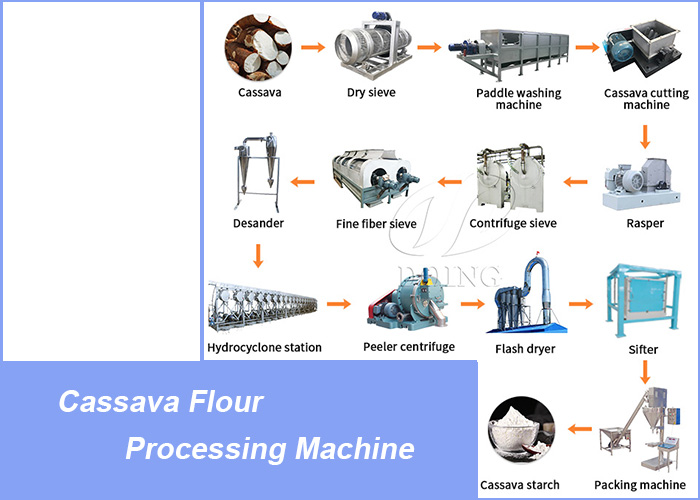 cassava flour processing machine
Step 3: Grating/Rasping
The cleaned, peeled roots are fed into a high-performance cassava grater or rasper. This machine reduces the cassava to a fine, homogeneous pulp, breaking open the cell walls to release starch granules. The fineness of the grate directly impacts flour quality and extraction yield.
Step 4: Dewatering
The wet cassava mash contains approximately 60-70% moisture. A plate-frame filter press removes excess water, producing a pressed cake with about 40% moisture. Proper dewatering reduces drying time and energy consumption significantly.
Step 5: Drying
This is the most critical step for producing premium gluten-free flour. The pressed cake is broken into small granules and fed into a flash dryer. Temperature is carefully controlled (typically 60-80°C) to dry the material rapidly without cooking or gelatinizing the starch. The target moisture content is 10-12%—dry enough for long shelf life but not so dry that the flour loses quality.
 cassava flash dryer
Step 6: Milling and Sieving
The dried cassava granules pass through a fine flour mill to produce fine flour. The flour then travels through vibrating sieves calibrated to specific mesh sizes, ensuring uniform particle size. Consistent granulation is essential for predictable performance in baking and cooking applications.
Step 7: Packaging
Finally, the gluten-free cassava flour is automatically weighed and sealed in moisture-proof packaging to preserve quality during storage and transport.
Ready to capture the growing gluten-free cassava flour market in Nigeria? Whether you are starting small or scaling up for export, we, Henan Jinrui, have the technology, experience, and local branch office (in Ogun State) to make your project succeed!
Leave A Message
- Do you want to buy machine?
- Yes, I want to buy machine
- No, I want to learn more in advance.
- What is your raw material?
- Cassava
- Potato
- Sweet potato
- Other:
- What is the final product you want to produce?
- Chips
- Flour
- Starch
- What is the final product you want to produce?
- Garri
- Cassava flour
- Cassava starch
- Cassava chips
- Attiekie
- Bammy
- Other:
- What is your planned capacity for final product?
- <1 ton per day
- 1 ton per day
- 2 tons per day
- 3 tons per day
- 3-10 tons per da
- 10-20 tons per day
- >20 tons per day
- What is the usage of your cassava chips?
- Food usage (like fried chips, flour)
- Industrial usage (like animal feeds, ethanol)
- What is your planned capacity for final product?
- <5 ton per hour
- 5-10 tons per hour
- >10 tons per hour
- What is your planned capacity for final product?
- <500 kg per hour
- 0.5-5 ton per hour
- 5-10 ton per hour
- >10 ton per hour
- What is your planned capacity for final product?
- <300 kg per hour
- 300-1000 kg per hour
- 1-5 ton per hour
- 5-10 ton per hour
- >10 ton per hour